ORBIShttps://orbisreadingatlas.com/read/city-light-and-sleep
Health
How do city lights affect sleep?
Most people now live under a night sky that never fully darkens. The body's clock reads that light as a signal.
Global · 30 September 2026
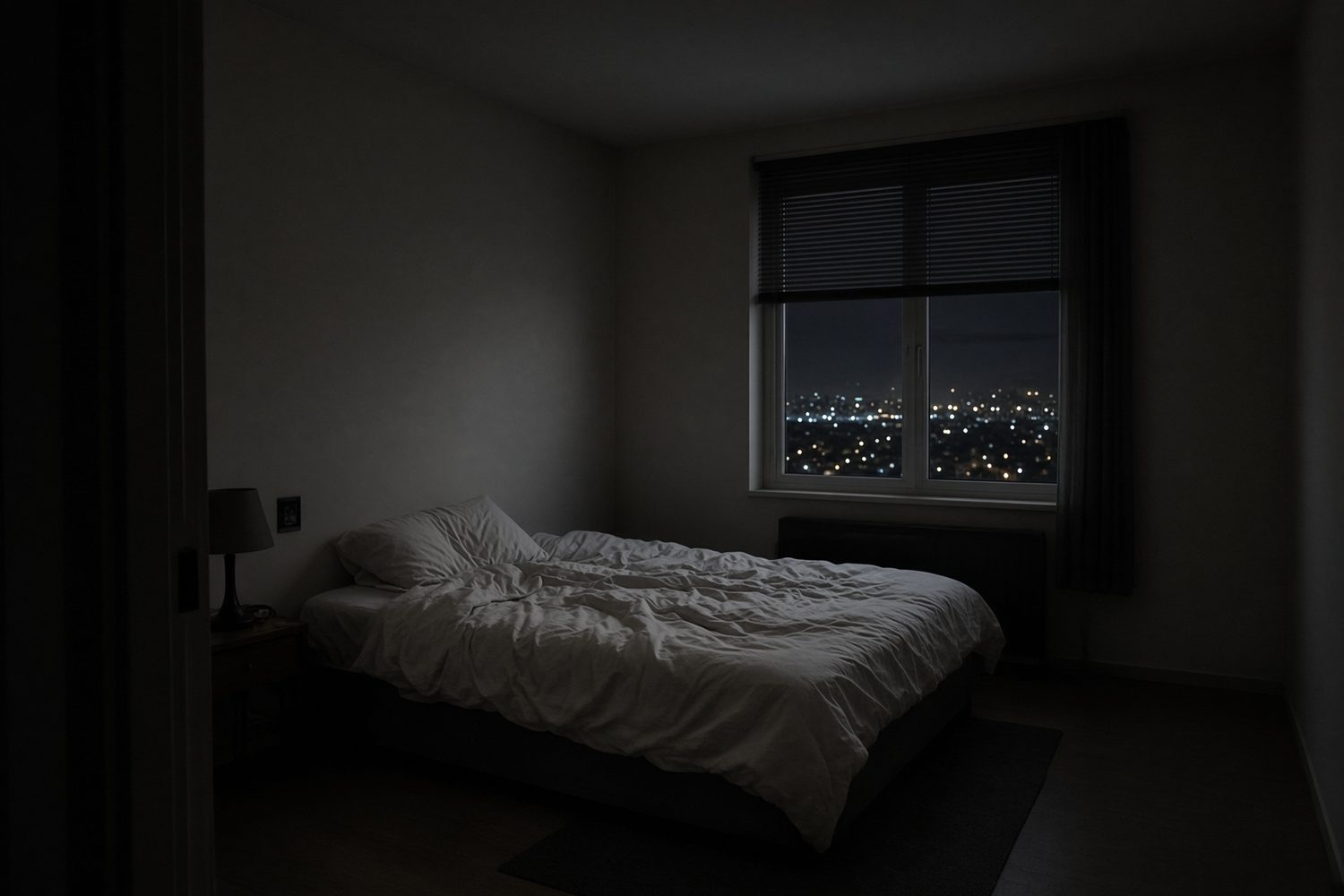
Most people now try to sleep under a sky that never truly darkens and whose stars are fading. A 2016 mapping found that over 80 percent of the world's population – and over 99 percent in the US and Europe – live under light-polluted skies, hiding the Milky Way from a third of humanity.source 1 From volunteers' reports between 2011 and 2022, Kyba and colleagues calculated that the sky is brightening by about 9.6 percent a year.source 2
Our bodies read light as a "time signal." Evening light, especially blue light, delays the release of melatonin, the hormone preparing us for sleep, and the white LEDs now common in street lighting emit a large share of their light in that blue range. A study of nearly 16,000 Americans found that people in brighter areas tended to go to bed later, sleep less, and feel less satisfied with their rest.source 3 The link is an association, not proof; the light that reaches a bedroom also depends on curtains and screens. Cities that want darker nights have simple tools: downward-pointing shielded lamps, warmer hues, and dimming in the late hours.
- 1Falchi et al.The new world atlas of artificial night sky brightness (Science Advances, 2016)doi.orghttps://doi.org/10.1126/sciadv.1600377
- 2Kyba et al.Citizen scientists report global rapid reductions in the visibility of stars from 2011 to 2022 (Science, 2023)doi.orghttps://doi.org/10.1126/science.abq7781
- 3Ohayon & MilesiArtificial Outdoor Nighttime Lights Associate with Altered Sleep Behavior in the American General Population (Sleep, 2016)doi.orghttps://doi.org/10.5665/sleep.5842
Related readings
Why the same heat kills more in some places
A heat wave is counted twice: by thermometers, and by the registers of deaths. Plans work on the gap between the two.
Health·3 min read
Bread on the table, and diabetes
What the grain has kept matters more than whether bread is eaten at all.
Health·2 min read
The register of trials
A study that never enters a public register is harder to find, and harder to count.
Health·1 min read
Comments
Loading…